QUESTION 01
AI IMPLEMENTATION FOR LOGISTICS · KENYA
Most of your team's day goes on work that is not the work.
Re-keying an invoice into a customs entry. Answering the same shipment question for the fourth time. Chasing a delivery note. Building the same report every Monday. Veridom eliminates that work for Kenyan freight forwarders, clearing agents and distributors — and leaves your people on the fraction that actually needs judgement. One workflow at a time, live in 14 days, measured for 30.
Two products live · Nairobi · Now scoping founding implementations
Live in 14 days.
Measured for 30.
Continue only if it works.
01 / WHAT LOGISTICS OPERATIONS ACTUALLY LOSE
The cargo moves fine. Everything around the cargo is the problem.
The smartest operators are already using AI here — not to replace people, but to stop spending them on repetition.
Manual operations. Records split across trucks, ports, WhatsApp threads, paper files and one person's memory. Limited visibility while a job is running. And revenue delayed not by the work, but by the documentation that proves the work happened.
- 01Repetitive customer communication.
"Where is my container?" answered by a person who first has to find out. The same enquiry, dozens of times a day, across WhatsApp, email and phone.
- 02Documentation handled by hand.
The same details re-keyed into entries, permits, delivery notes and client submissions — and mismatches discovered after lodgement instead of before.
- 03Deadlines nobody is watching.
Free days, storage clocks, empty returns, licence and insurance renewals. Each one has a cost, and each one is tracked in somebody's head.
- 04Work completed but never billed.
Deliveries finished with no proof anyone can produce, client submissions never acknowledged, invoices never raised because nobody knew the job was done.
- 05No answer to "what happened".
A demurrage dispute, a customs query, a client refusing to pay. The answer exists in a chat thread and a paper file, and reconstructing it takes a day.
None of this needs more staff. It needs the repetitive nine-tenths handled reliably and the exceptional tenth put in front of a person while it can still be fixed. That is the work we implement.
02 / THE TEST
Pick a delivery from three weeks ago.
Four questions. Answer honestly — nothing leaves this page.
QUESTION 02
Were the required documents sent to the client?
QUESTION 03
Was it invoiced?
QUESTION 04
Was it paid?
YOUR OPERATION
0of four answerable
from one operating record
from one operating record
The delivery happened. The evidence did not complete the journey.
A driver leaves the customer's yard. The signed note stays in the cab, a WhatsApp thread or a paper file. Operations assumes finance has it. Finance cannot raise the invoice. The client says the documents never arrived. And the owner starts reconstructing a job that was finished a fortnight ago.
Nothing in that chain is a technology failure. It is a record that was never kept in one place while the work was happening.
03 / WHAT WE AUTOMATE
Four areas where the back office stops being manual.
This is the practice, not a product list. Every implementation is scoped to one workflow inside one of these, configured to your operation and measured against how it runs today.
AREA 01
Zero-touch document workflows
The largest single pool of manual hours in a clearing operation, and the most automatable.
- Commercial invoice extraction into entries. The supplier invoice is read and the declaration populated from it, with HS classification proposed and checked rather than retyped from a PDF at midnight.
- Discrepancy detection across documents. Bill of lading, packing list and commercial invoice compared against one another — weight, piece count, value and consignee mismatches surfaced before lodgement instead of after a query.
- Quote generation from inbound RFQs. A rate request arriving by email is parsed, checked against your rates and carrier options, and a response drafted for review — while the enquiry is still warm.
- Permits, certificates and licences. What each consignment requires, what has been obtained, what expires when, and what is missing from a submission that is about to go out.
AREA 02
Carrier, capacity and commercial work
Where margin is won and lost, and where most operations still work from memory and a phone.
- Capacity sourcing. Historical movement patterns used to anticipate which carriers are likely to have capacity or empty backhauls on your lanes, rather than ringing round from the top of a list.
- Rate negotiation inside your guardrails. Counter-offers prepared, or sent, within margin floors and ceilings you set in advance. The guardrail is the point — the negotiation is bounded before it starts.
- Carrier vetting and compliance monitoring. Insurance expiry, licence status, NTSA records and risk signals watched continuously instead of checked once at onboarding and never again.
- Cost reconciliation. Invoiced charges compared against what was quoted and what the job actually incurred, with the differences listed rather than absorbed.
AREA 03
Customer experience and exception management
Not a chatbot. The difference between reporting a problem and doing something about it.
- Proactive exception handling. Not a milestone reading “delayed” — the ETA impact calculated, the affected commitments identified, alternatives proposed and the client notification drafted before they ask.
- Shipment enquiries answered around the clock. From verified operational state, with what cannot be supported routed to a named person rather than guessed. This is the AI Shipment Desk.
- Delivery evidence and revenue recovery. Proof captured from the photograph a driver already sends, checked while correction is possible, and completed work nobody billed put on a screen. This is the Delivery Desk.
- Client-specific requirements held once. What each customer demands as documentation, proof and notification — recorded against the account instead of remembered by whoever has dealt with them longest.
AREA 04
Institutional memory that actually works
The one nobody sells you, and the one that compounds.
- Answers in the flow of work, with sources. Why was this consignment routed that way? Who approved that exception? What did we agree with this client in March? Answered from the record, with permissions respected and the source attached — not reconstructed from a chat thread.
- The end of the Monday report. Most knowledge work is still organised around periodic reports and hand-maintained dashboards. A brief that composes itself from what actually happened replaces the person who spends every Monday morning assembling one.
- Expertise that survives departures. The person who knows which client needs the special certificate, and which line queries which classification, is currently your single point of failure. That knowledge becomes part of the operating record.
- Decisions with their reasoning intact. What was decided, on what evidence, by whom, and what changed afterwards. This is the layer every other capability writes into — and the reason the second implementation costs less than the first.
Not everything here suits every operation, and we will tell you which ones do not suit yours. That is what the mapping stage is for.
04 / TWO WAYS TO START
Two of those are already built and running.
Most implementations are built to your workflow from the mapping stage. These two are packaged, working today, and the fastest way in — which is why most operators start with one of them rather than from a blank page. Both write to the same operating record, so whatever you build next begins from what these already learned.
PRODUCT 01
The AI Shipment Desk
For established forwarders with systems, a tracking page and real enquiry volume.
“Can it actually do the work?”
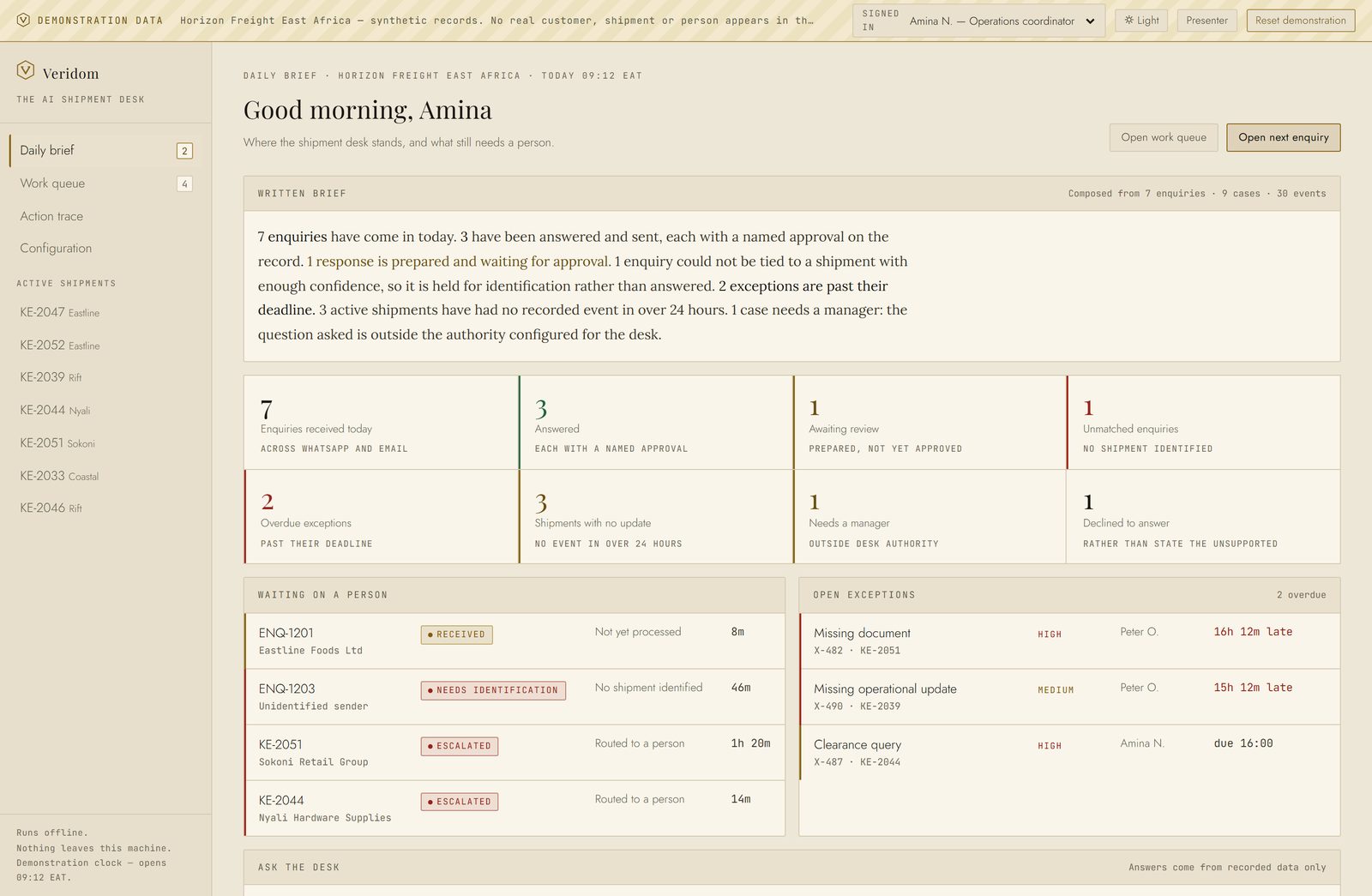
A customer asks where a shipment is. The Shipment Desk identifies the customer and the consignment, retrieves the verified operational state, prepares a response from approved information only, and refuses to state anything the record does not support. What it cannot answer becomes a routed exception with a named owner, not a guess.
- Shipment enquiry intake from WhatsApp and email
- Customer and consignment matching
- Responses drawn only from verified records
- Exceptions routed to a named person
- Full record of what was answered, by whom and on what basis
 How the Shipment Desk works →
PRODUCT 02
The Delivery Desk
For owner-operated transport and distribution running on WhatsApp, paper and memory.
“Where is my money?”
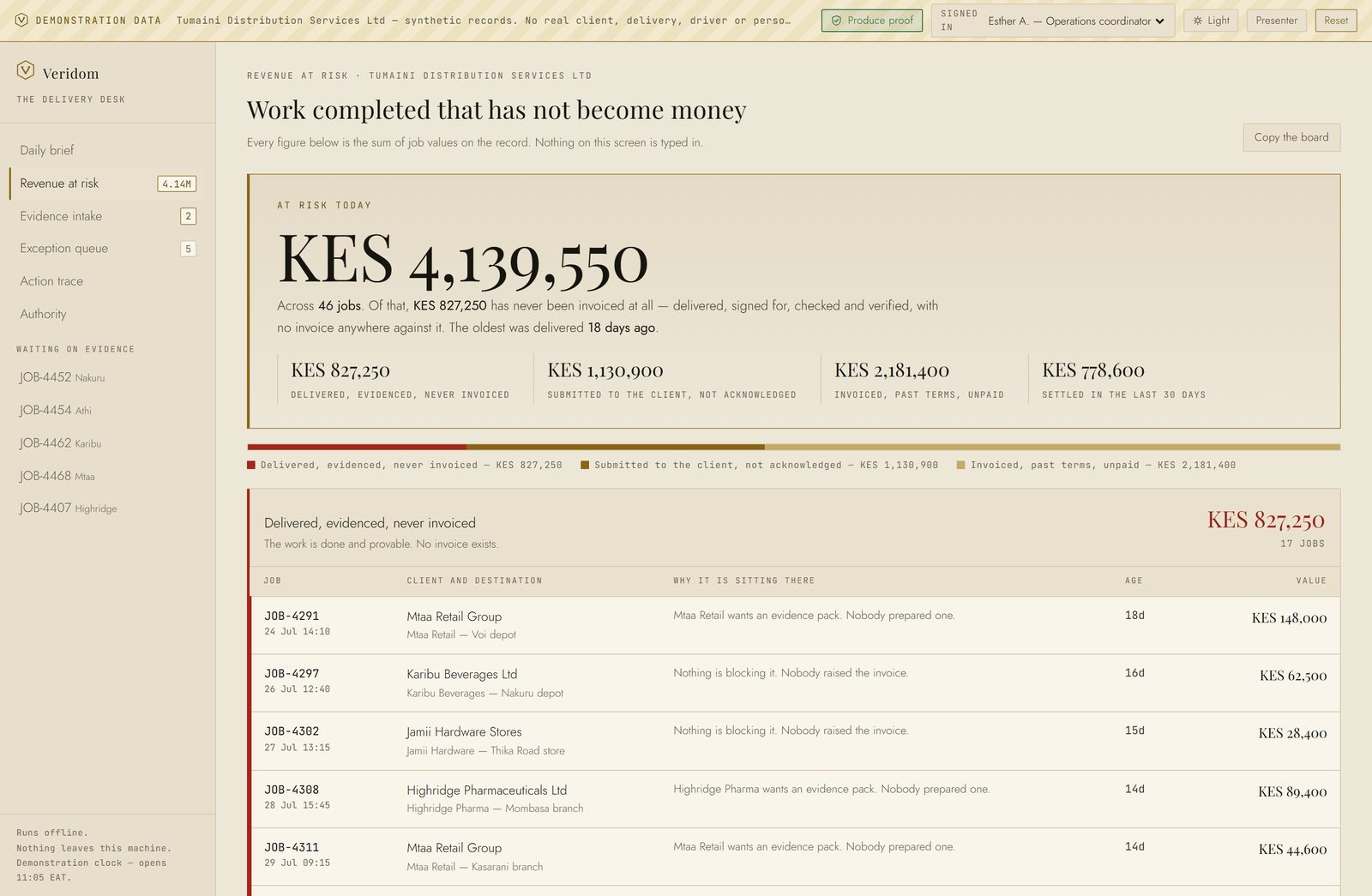
A driver photographs a signed delivery note and sends it to a WhatsApp number, exactly as he does today. It becomes structured proof of delivery attached to the right job — recipient, signature, date, quantities, checked against what was dispatched. If something is missing, it says so while the truck may still be reachable. And completed work that nobody billed appears on one screen with a figure against it.
- No driver app. No login, no training, no new habit
- Proof of delivery captured from a photograph
- Evidence checked while correction is still possible
- Revenue at risk: delivered, never invoiced
- Client submissions and payment status tracked
 How the Delivery Desk works →
Screenshots are of the running demonstrations. Synthetic companies and records throughout — no real customer, shipment, delivery or person appears in them.
Not sure which? One question decides it: what usually goes wrong between a delivery being completed and you getting paid for it? If the answer is “nothing — it is the enquiries that kill us,” start with the Shipment Desk. If you had to think about it, start with the Delivery Desk.
05 / THE IMPLEMENTATION
One workflow. Live in 14 days. Measured for 30. Continue only if it works.
A fixed implementation fee covers rapid mapping, configuration, testing, deployment and a thirty-day measurement period against how the workflow ran before. Recurring operation begins only if you choose to continue.
The Kenyan market benchmark for an AI pilot is four to eight weeks to go live, on an open-ended engagement. We think that is the wrong shape for an operator who has been burned before, so we made ours short, fixed and reversible.
14days to live
30days measured
1workflow at a time
0lock-in if it fails
06 / WHY THESE PROJECTS FAIL
Most AI projects in logistics are quietly abandoned by month three.
Not because the technology did not work. Because of two things that are decided before any of it is built.
The first is that it was built on information the business does not actually have. A tool assumes there is a clean record of what a job is, what proves it is finished and who may approve an exception. In most operations that lives in the owner's head. The tool asks for inputs nobody can supply, so the team stops supplying them.
The second is that nothing accumulates. The first automation is a standalone script. So is the second. By the fourth, there are four disconnected tools, four sets of credentials, no shared record of what any of them did, and nobody who can say what happened on a job three weeks ago.
We address the first by mapping the workflow before we build anything. We address the second with The Keen — the operating layer your implementations are delivered on. It holds the job, what was done, what proves it and what is still missing, so the second implementation starts from what the first already learned rather than from zero.
You are not buying The Keen. You are buying an AI implementation on one workflow. The Keen is why the one after it costs less and why the first one is still running in month twelve.
- →Built on a verified map
Not on assumptions about records the business has never kept.
- →One shared operating record
Every implementation writes to the same history instead of its own silo.
- →Bounded authority
What may act on its own, and what stops and goes to a person — agreed in writing before anything runs.
- →Measured against the old process
So "it is working" is a number, not an impression.
07 / THE MORNING BRIEF
Six lines that replace an hour of asking.
This is what the operating record makes possible: a single message, before the day starts, that says what completed, what is incomplete and what is waiting on a decision.
It is not a dashboard anyone has to remember to open. It arrives where the team already is.
THE KEENdaily brief
06:30
Good morning.
11 deliveries were recorded yesterday.
8have complete delivery evidence.
2are missing signed delivery notes.
1cannot be matched to an active job.
3completed deliveries have no invoice.
2items require your decision.
Illustrative example. The content of your brief is defined by your workflow map.
THE FOUNDING PROGRAMME
Now scoping founding implementations.
You choose the desk. Veridom maps that workflow, configures the build around how your operation currently works, establishes a baseline from real jobs, and deploys it — the enquiry handling and exception routing of the Shipment Desk, or the evidence capture and revenue recovery of the Delivery Desk.
Founding operators work directly with the Veridom team, influence which capabilities are built next, and receive a fixed-scope implementation rather than a generic software setup.
We are beginning with a limited number of Nairobi operations, so every implementation can be verified against real work before the programme expands.
08 / CONFIGURATION
Mapping is not the product. It is how the implementation learns your business.
Nothing can be automated reliably until somebody defines what "complete" means in your operation — what counts as a job, as proof, as an approved exception, as an authorised action. Mapping establishes those definitions and becomes the specification we implement against. You keep the map either way.
Delivery to cash
Map how a completed delivery becomes proof, an accepted client submission, an invoice and finally payment — and where documents disappear, responsibility blurs, or finished work never reaches finance.
First deploymentDocument preparation and checking
Map which documents each shipment and each client actually requires, who prepares them, what is checked against what, and where mismatches are currently discovered — too late, or not at all.
Compliance documentation and filings
Map the regulatory obligations the operation carries — customs entries, permits, certificates, licence and insurance renewals — what each submission depends on and who is accountable for it. Once those requirements are defined, The Keen can prepare and check submissions against them, and flag what is missing before a deadline rather than after.
Highest automation potentialDeadline and renewal control
Map the clocks the operation runs against — free days, storage, empty returns, licences, insurance — where each one is tracked today, and who is responsible when one is approaching.
Quote preparation
Map how a rate request becomes a quote: what it is priced against, who approves it, how long it takes, and what happens to the ones that are never answered.
One at a time.
We do not map five workflows at once. We start with the one closest to your cash, prove the method on it, and connect the next only when it has been mapped and approved.
Start with one workflow09 / HOW AN IMPLEMENTATION RUNS
Map one workflow
We sit with the people who do the work and document how it actually runs, exceptions and unofficial workarounds included, then verify it with them. That map becomes the configuration The Keen is built against.
Deploy and measure
Delivery to cash goes live — document checking, job coordination, invoice readiness and the daily brief — with the boundaries agreed in writing beforehand, and a baseline captured so the change is measurable.
Add the next workflow
Further implementations connect to the same operating record rather than starting again from zero — but only once they have been mapped and you have approved them.
10 / THE DIFFERENCE
The winning model is not unsupervised AI employees. It is exception-driven work, where people supervise the fraction that needs judgement.
That is the whole design. The repetitive nine-tenths runs; the exceptional tenth reaches a named person with everything they need to decide. Nobody supervises what does not need supervising, and nothing consequential happens without someone who is accountable for it.
Making that work needs something underneath it. In logistics the question always comes back — a demurrage dispute, a customs query on a lodged entry, a client refusing to pay without proof of delivery. The Keen keeps that answer while the work is happening rather than reconstructing it afterwards, separating what was observed from what was inferred, what was recommended from what was approved, and what was executed from what was refused.
And it is what makes the boundary real rather than a promise. Capability and authority are separate dials here. What the system can do keeps growing; what it may do is written down, scoped per category of action, and moved only by you — upward when the measurement earns it, downward the moment it does not.
11 / WHAT THE IMPLEMENTATION DELIVERS
A deployed AI workflow, and the map it was built from.
- 01One workflow, deployed.
Your chosen desk running live — enquiry handling or delivery evidence — with the case records, exception routing and daily operating brief that go with it.
- 02A record of completion for every job.
What counts as proof at each stage, and whether it is present, missing or disputed right now.
- 03Exceptions routed to a named person.
Blocked work and decisions reach whoever owns them, instead of accumulating until you ask.
- 04Agreed boundaries, in writing.
What the implementation may prepare on its own, what requires approval, and what it must never touch.
- 05A verified workflow map you own.
One process documented end to end, in a form your people recognise as true. Yours to keep, whatever you decide next.
- 06A measured baseline.
How the workflow ran before the implementation, so the difference afterwards is a number rather than an impression.
12 / QUESTIONS
The things operators actually ask.
If yours is not here, ask it on WhatsApp. You will get a straight answer, not a brochure.
01What can AI actually automate in a Kenyan logistics company?
More than most operators expect. Reading a supplier invoice and populating a customs declaration from it. Comparing the bill of lading, packing list and commercial invoice against each other and surfacing the mismatch before lodgement. Parsing an inbound rate request and drafting the quote. Watching every free day, storage clock and empty return at once. Capturing and checking delivery evidence. Answering routine shipment enquiries around the clock. Surfacing completed jobs nobody invoiced, and reconstructing why a decision was made eighteen months ago. Where it stops is a setting rather than a technical ceiling: most operators keep the judgement calls supervised — accepting a disputed charge, pricing a genuinely unusual job, deciding an exception — and let the routine nine-tenths run. Each category sits at an authority level you set in writing and move as the measurement earns it.
02How much does an AI implementation cost, and how long does it take?
We work to a fixed implementation fee agreed in writing before we start, covering mapping, configuration, testing, deployment and a thirty-day measurement period. One workflow goes live in fourteen days. The common benchmark in the Kenyan market is four to eight weeks to a pilot on an open-ended engagement — we deliberately made ours shorter, fixed and reversible, because most operators here have been burned by a project that never finished.
03Do our drivers need to install an app?
No. This is the difference between the Delivery Desk and the delivery-management platforms you may have looked at. A driver photographs the signed delivery note and sends it to a WhatsApp number, exactly as he already does. No app, no login, no training, no new habit. Driver adoption is the single most common reason these deployments fail in this market, so we removed the requirement entirely.
04Is this compliant with Kenya’s Data Protection Act?
Data protection is treated as part of the implementation, not an afterthought. We define during mapping what personal data the workflow touches, where it is held, who may see it and how long it is kept, and we will sign an NDA and a data-processing agreement before any of your records are involved. Your rates, clients and documents remain yours.
05Does this replace the systems we already use?
No. The implementation is configured around the systems and channels your operation already runs on — including WhatsApp, email and paper. Mapping identifies what should stay as it is, what needs connecting, and the few places where a single authoritative record has to exist for anything else to work.
06Do we need clean data before we start?
No, and if you did, nobody in this sector would ever start. Finding the missing, contradictory and owner-held information is part of the work, not a prerequisite for it. That is precisely why we map before we build.
07Will the AI do things without asking us?
Only inside limits you agree in advance, in writing, per category of action. Everything else stops and goes to a named person. The Keen records what it did, what evidence it relied on and who authorised it — including the things it refused to do.
08How does workflow mapping relate to the implementation?
Mapping is the first, fixed-scope stage of the implementation, and it is how the build is configured to your operation rather than imposed as a template. The map is the specification we implement against. You own it, and you decide whether to proceed to deployment.
09Who sees our information?
We will sign an NDA before the first session if you want one. Your rates, clients and documents are yours, and nothing about your operation appears on this website or anywhere else without your written agreement.
10Why freight forwarding, and why Kenya?
Because the conditions here are the hard case, not the easy one. Fragmented infrastructure, paper evidence, informal handoffs and owner-led controls are the industry-wide condition — Kenyan freight forwarding is just where they are most visible and where the cost of a missing document is most immediate. It is a demanding test environment, and that is the point: an operating layer proven against these conditions is built on far fewer assumptions than one designed for operations that already have clean systems.
ONE WORKFLOW · LIVE IN 14 DAYS · MEASURED FOR 30
Start with the workflow costing you most.
Thirty minutes with the people who do the work is enough to scope your first implementation, and to tell you honestly what can be automated now, what needs fixing first, and what should stay with a person. You keep the workflow map either way.
Guides: reducing demurrage and storage charges · finding unbilled deliveries · proof of delivery requirements · for clearing and forwarding agents.
Veridom builds the evidence and authority infrastructure underneath these implementations — the technical foundation is here.