PRODUCT 02 · PROOF OF DELIVERY · NO DRIVER APP

Your driver already takes the photo. Nothing collects it.

The Delivery Desk turns the photograph a driver sends to a WhatsApp number into structured proof of delivery, attached to the right job and checked against what that client actually requires. No app for your drivers, no login, no training. And completed work nobody billed appears on one screen with a figure against it.

Live in 14 days · Measured for 30 · Nairobi

For owner-operated transport
and distribution running on
WhatsApp, paper and memory.

01 / THE PROBLEM

Work is completed long before it is provable, and provable long before it is paid.

The gap between those three states is where the money goes — not through theft, but through a delivery note in a driver’s pocket, a client who says the paperwork never arrived, and an invoice nobody raised because nobody knew the job was finished. The owner is the only person who can close that gap, so the owner checks everything, and the business stops growing at the edge of one person’s attention.

  • 01
    Proof that exists only in a cab.

    The signed delivery note is real, and it is in a vehicle, a jacket or a WhatsApp thread nobody can search. When a client disputes the delivery, you cannot produce it quickly enough to matter.

  • 02
    Defects found far too late.

    A missing signature or a wrong recipient name is discovered when the client rejects the submission — weeks after the truck could have gone back.

  • 03
    Every client wants different proof.

    One needs a stamp, one needs quantities confirmed, one needs photographs of the goods. Nobody has written the requirements down, so they are met by memory and missed regularly.

  • 04
    Completed work that was never billed.

    Deliveries finished, evidence intact, and no invoice ever raised — because the completion never reached anyone whose job it is to bill it.

  • 05
    The owner as the operating system.

    You know which client needs the special document, which driver has not sent the note back and which invoice is blocked. That knowledge keeps it moving, and it is also the ceiling.

The fix is not a new app for your drivers to ignore. It is collecting what they already send, and refusing to call a delivery complete until the evidence says it is.

02 / HOW IT WORKS

A photograph becomes a record. A defect becomes an alert. A gap becomes a number.

01 — CAPTURE

The photo he already takes

A driver photographs the signed delivery note and sends it to a WhatsApp number, exactly as he does today. The desk extracts the note number, date, recipient name, signature, quantities and any condition remarks, and attaches it to the correct open job. Nothing about the driver’s behaviour changes.

02 — CHECK

Against what this client requires

Evidence is checked against that client’s specific requirement set. A missing signature, an absent recipient name or a quantity that does not match what was dispatched becomes a named defect with a named owner — flagged while the truck may still be reachable and correction is still possible.

03 — RECOVER

Show the money nobody billed

Deliveries completed with full evidence and no corresponding invoice appear on one board with a shilling value against them. Submissions sent but never acknowledged, and invoices past terms, sit beside them.

03 / WHAT IT DOES

What it captures, what it checks, and what it puts in front of you.

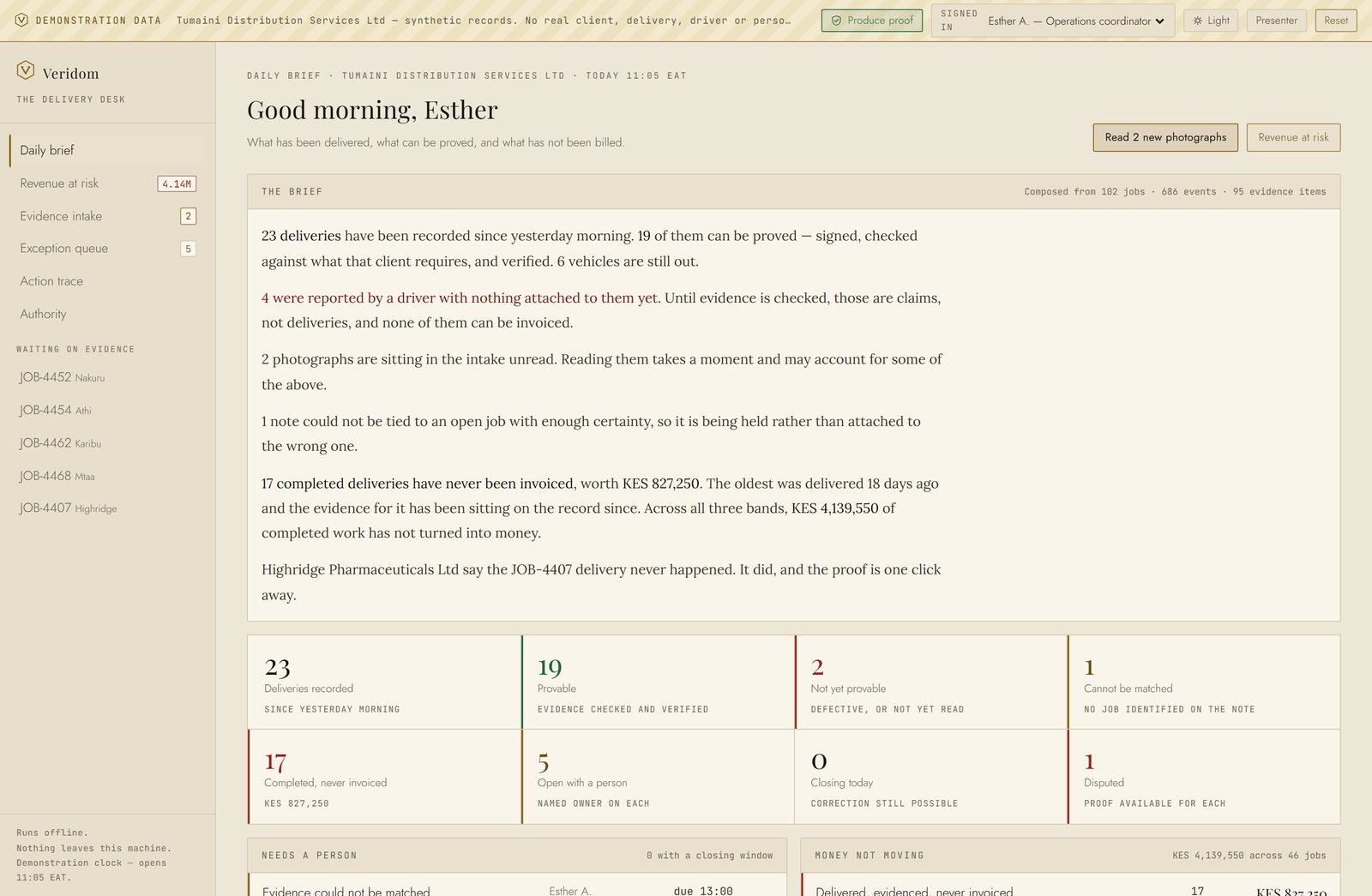
The Delivery Desk daily brief showing deliveries recorded, provable, and completed but never invoiced
The daily brief. Twenty-three deliveries recorded, nineteen provable, four reported by a driver with nothing attached yet — and those four are claims, not deliveries, so none of them can be invoiced. Demonstration data.
  • 01
    Evidence intake over WhatsApp

    Image and text, from the number the driver already uses. No driver app, no login, no training and no new habit — the single most common reason delivery deployments fail in this market.

  • 02
    Proof-of-delivery extraction

    Delivery note number, date, recipient name, signature presence, quantity and condition remarks, pulled from the photograph and matched to an open job.

  • 03
    Per-client evidence requirements

    Signature, stamp, recipient name, confirmed quantities, photographs of goods, original returned — defined once per client instead of remembered per delivery.

  • 04
    Defect detection with a correction window

    A specific failure against a specific requirement, with what to do about it and how long there is to do it, assigned to a person rather than added to a pile.

  • 05
    Claimed is not the same as complete

    A driver saying it was delivered is a claim. A validated proof of delivery is evidence. The desk never collapses the two, and the difference is visible at a glance.

  • 06
    The revenue-at-risk board

    Delivered with evidence and never invoiced. Submitted and never acknowledged. Invoiced and past terms. Each with a value.

  • 07
    Dispute retrieval in seconds

    A client challenges a delivery from six weeks ago; the complete evidence and timeline for that job come back immediately instead of after an afternoon of searching.

  • 08
    A daily operating brief

    What completed, what is missing evidence, what is blocked and what needs your decision — before the day starts.

04 / THE DIFFERENCE

A driver saying it was delivered is a claim. A validated proof of delivery is evidence.

Everything downstream depends on that distinction holding. Submission, invoice, payment and dispute all rest on whether the business can tell the difference between work somebody says happened and work it can prove happened.

Most systems collapse the two the moment a driver marks a job done. The Delivery Desk keeps them apart and makes the gap visible: this job is claimed, that one is evidenced, and here is precisely what is missing from the first.

It is also why the product refuses. It will not prepare a client submission, and it will not call a delivery invoice-ready, on evidence that does not meet that client’s requirements. An owner in a low-trust environment needs software that declines, not software that is confident.
04.1 / ON THE SCREEN

The number most owners have never seen.

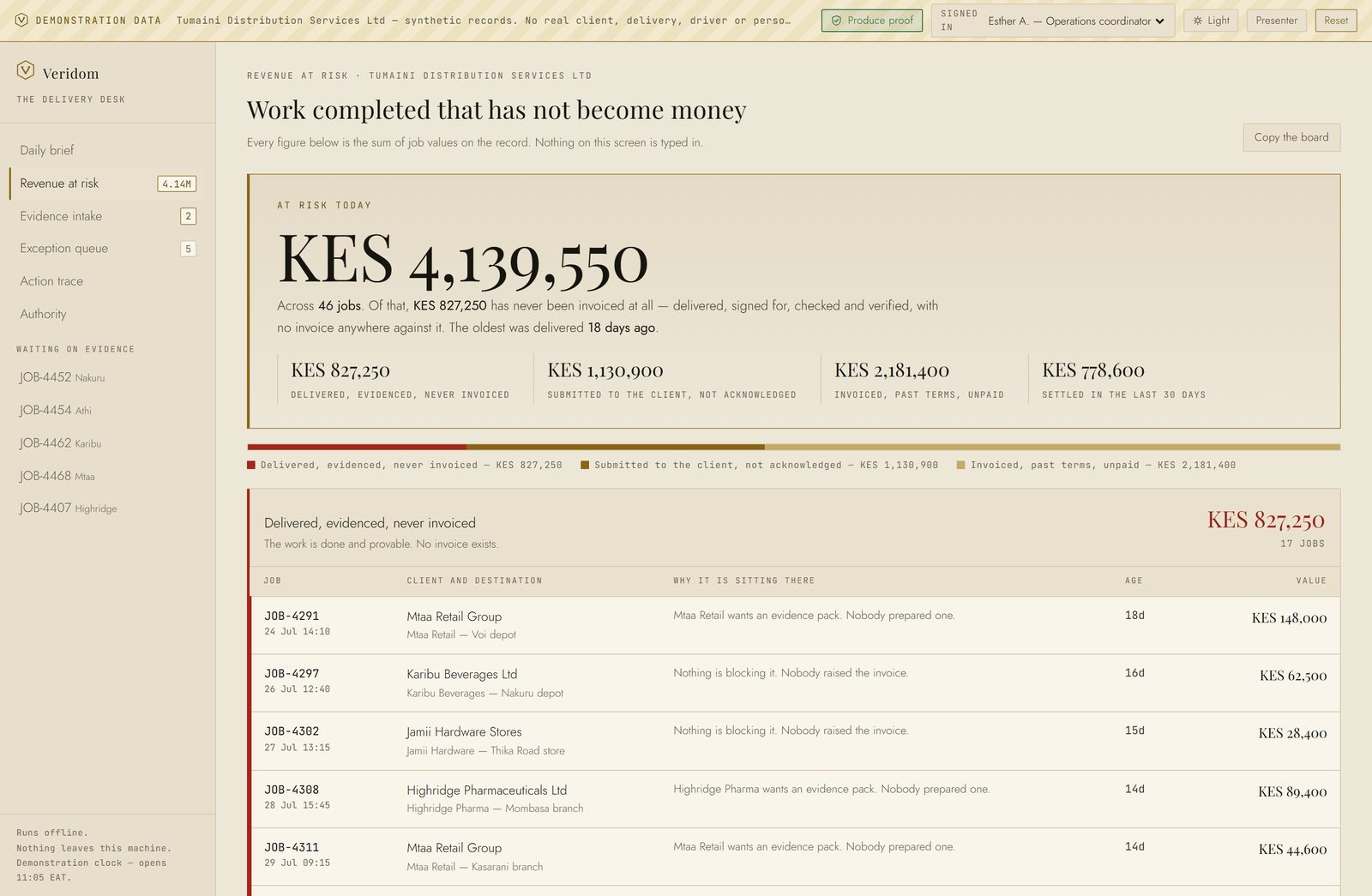
The Delivery Desk revenue-at-risk board listing completed deliveries that were never invoiced with a value against each
The revenue-at-risk board. Completed, evidenced, never invoiced — with a figure against it, and the oldest one dated. Demonstration data, but the number is the reason owners sit forward.

05 / WHERE YOU SET THE LINE

You decide how far it goes — and you can move that line.

The question is almost never whether AI can do something. It usually can. The question is what you are willing to let it do without asking, on which categories of work, and how you change your mind later. That is a governance decision, and it belongs to you.

Capability and authority are separate dials. Most tools ship them welded together — whatever the model can do, it does. Here they are set independently, per category of action, and you hold the second one.

  • 01  Observe

    It reads the photographs, notes and job records you authorise, and keeps the history. Nothing acts, nothing is sent.

  • 02  Recall

    A client disputes a delivery from six weeks ago and the complete evidence comes back in seconds, with its sources. Retrieval only.

  • 03  Recommend

    It tells you this note is missing a signature, that job has no invoice, this submission was never acknowledged — and a person acts.

  • 04  Prepare

    It drafts the client submission, the chase message to the driver, the invoice ready for your accounting system. Held for approval. Most operators live here at first.

  • 05  Execute within bounds

    It sends the submission, files the evidence pack or raises the draft on its own — inside the categories, thresholds and client accounts you have opened, reversibly and on the record. Chasing a driver for a missing signature goes here quickly. Anything that moves money goes here slowly.

  • 06  Escalate and learn

    A note that cannot be tied to a job with confidence is held, not attached to the nearest plausible one. It goes to a named person, and how they resolved it becomes part of what it knows.

Each category sits at its own level, written down before deployment and changed only by you. Chasing a driver might reach level 5 in week one. Issuing an invoice may stay at level 4 for a year, or forever — that is your call, not ours, and not the software’s. This also means the Desk sits happily alongside dispatch and tracking tools you already run; it governs the evidence and the money, which is the part they leave to you.

06 / THE IMPLEMENTATION

One workflow. Live in 14 days. Measured for 30. Continue only if it works.

A fixed implementation fee covers rapid mapping, configuration, testing, deployment and a thirty-day measurement period against how the workflow ran before. Recurring operation begins only if you choose to continue.

14days to live
30days measured
1workflow at a time
0lock-in if it fails

07 / QUESTIONS

What owners ask before they say yes.

If yours is not here, ask it on WhatsApp. You will get a straight answer, not a brochure.

01How do I get proof of delivery without making drivers use an app?

The driver photographs the signed delivery note and sends it to a WhatsApp number, which is what most drivers already do informally. The Delivery Desk collects that photograph, extracts the delivery note number, date, recipient name, signature and quantities, and attaches it to the right job. No download, no login, no training. Driver adoption is the most common reason proof-of-delivery projects fail in Kenya, so the requirement was removed entirely rather than made easier.

02How is this different from Onfleet, Detrack, Track-POD or LETA?

Those are dispatch and tracking platforms: routes, live vehicle positions, driver apps. They answer “where is the truck?” The Delivery Desk answers “can we prove this was delivered, and did we bill for it?” It requires no driver app, checks evidence against each client’s specific requirements, and shows completed work that was never invoiced with a value against it. If you already run one of those for dispatch, this sits alongside it rather than replacing it.

03What counts as valid proof of delivery?

It depends on the client, which is exactly the problem. One requires a signature and a company stamp, another requires the recipient’s printed name and confirmed quantities, another requires photographs of the goods. The Delivery Desk holds an evidence requirement set per client and checks each delivery against the right one, instead of relying on somebody remembering which client is which.

04What happens if the photo is blurry or the note is incomplete?

It does not accept it and does not mark the job delivered. It states which specific requirement failed — no signature, missing recipient name, quantity mismatch against dispatch — assigns it to a named person, and flags it inside a correction window while the truck may still be reachable. Catching the defect on the day beats discovering it when the client rejects the submission three weeks later.

05Can it show which deliveries were never invoiced?

Yes, and it is usually the moment an owner sits forward. The revenue-at-risk board lists deliveries completed with full evidence that have no corresponding invoice, client submissions sent but never acknowledged, and invoices past terms — each with a shilling value. Most operators have never seen that number, because nothing in the business was built to produce it.

06Do we need to change how our drivers or office staff work?

Drivers change nothing. The office changes one thing: instead of checking every delivery, a coordinator works an exception queue of the deliveries that have a problem. That is the point — the same people, pointed at the ten jobs that need attention rather than the ninety that do not.

07How long until it is live, and what does it cost?

One workflow live in fourteen days on a fixed implementation fee agreed in writing before we start, covering mapping, configuration, testing, deployment and a thirty-day measurement period against how the work ran before. Recurring operation begins only if you choose to continue. The Kenyan benchmark for an AI pilot is four to eight weeks on an open-ended engagement.

08Is our delivery and client data safe?

We sign an NDA and a data-processing agreement before any of your records are involved. The mapping stage defines what personal data the workflow touches — recipient names and signatures included — where it is held, who may see it and how long it is kept, consistent with Kenya’s Data Protection Act. Your clients, rates and documents remain yours.

ONE WORKFLOW · LIVE IN 14 DAYS · MEASURED FOR 30

Find the work you never billed for.

Thirty minutes with the people who handle deliveries and invoices is enough to scope the first implementation and tell you honestly what can be automated now, what needs fixing first, and what should stay with a person. You keep the workflow map either way.

NAIROBI, KENYA · FIXED-SCOPE IMPLEMENTATION · ONE WORKFLOW AT A TIME

Running an established forwarding operation where the pain is enquiry volume rather than evidence? The AI Shipment Desk answers from records you already keep. Or start with the overview of AI for logistics operations.