PRODUCT 01 · SHIPMENT ENQUIRY AUTOMATION · KENYA

Your team answers the same shipment question forty times a day.

The AI Shipment Desk handles routine customer shipment enquiries for freight forwarders and clearing agents. It identifies the customer and the consignment, retrieves the verified operational state, and prepares an answer from approved information only. What it cannot support from the record, it refuses to say — and routes to a named person instead.

Live in 14 days · Measured for 30 · Nairobi

For established forwarders
with systems, a tracking page
and real enquiry volume.

01 / THE PROBLEM

Answering "where is my container?" should not require a person to go and find out.

In most freight operations a routine enquiry costs a coordinator ten minutes: identify who is asking, work out which consignment they mean, check two or three systems and a WhatsApp thread, confirm the state is current, decide what may be disclosed to this customer, and compose a reply. Multiply that by the enquiries arriving before lunch.

  • 01
    The same question, all day.

    Status requests arrive by WhatsApp, email and phone, in no particular format, from customers who do not know their own consignment reference.

  • 02
    Answers that require an archaeologist.

    The current state lives across a tracking portal, an email chain, a clearing agent’s message and somebody’s memory. Assembling it is the job, not answering.

  • 03
    Confident answers that turn out to be wrong.

    Somebody replies from what they remember rather than what is recorded, the shipment has moved since, and the correction costs more trust than the original delay.

  • 04
    Disclosure decided in the moment.

    What may be told to which customer — rates, delays, the reason for a hold — gets decided ad hoc by whoever happens to reply.

  • 05
    Your best coordinator is a search engine.

    The person who knows the operation best spends their day retrieving information instead of resolving the exceptions only they can resolve.

None of that is a staffing problem. It is a retrieval problem wearing a staffing problem’s clothes — and retrieval is precisely what this should be handling.

02 / HOW IT WORKS

Enquiry in. Verified answer out. Anything uncertain stops.

01 — IDENTIFY

Who is asking, and about what

An enquiry arrives through WhatsApp or email in whatever form the customer sent it. The desk matches the sender to a known customer contact and the message to a specific consignment, even when the customer quotes the wrong reference or none at all.

02 — VERIFY

Retrieve the state, not a recollection

It reads the current operational state from your authorised records and derives it from the latest valid event rather than a manually overwritten field. It also establishes what this particular customer is permitted to be told.

03 — ANSWER OR ESCALATE

Prepare a reply, or refuse and route

Where the record supports an answer, it drafts one, shows the sources it used, and holds it for approval under whatever rule you set. Where the record does not support an answer, it says exactly what is missing and assigns it to a named person.

02.1 / SEE IT RUNNING

Ninety seconds of the desk answering, and refusing.

Filmed against the running product, not re-enacted. Every word in the frame came out of the application — including the moment it declines to state a delivery estimate no approved source supports, and routes it to a named person instead.

Demonstration data throughout — Horizon Freight East Africa is a synthetic company. No real customer, shipment or person appears in it.

03 / WHAT IT DOES

What the desk actually does, and what it shows you while doing it.

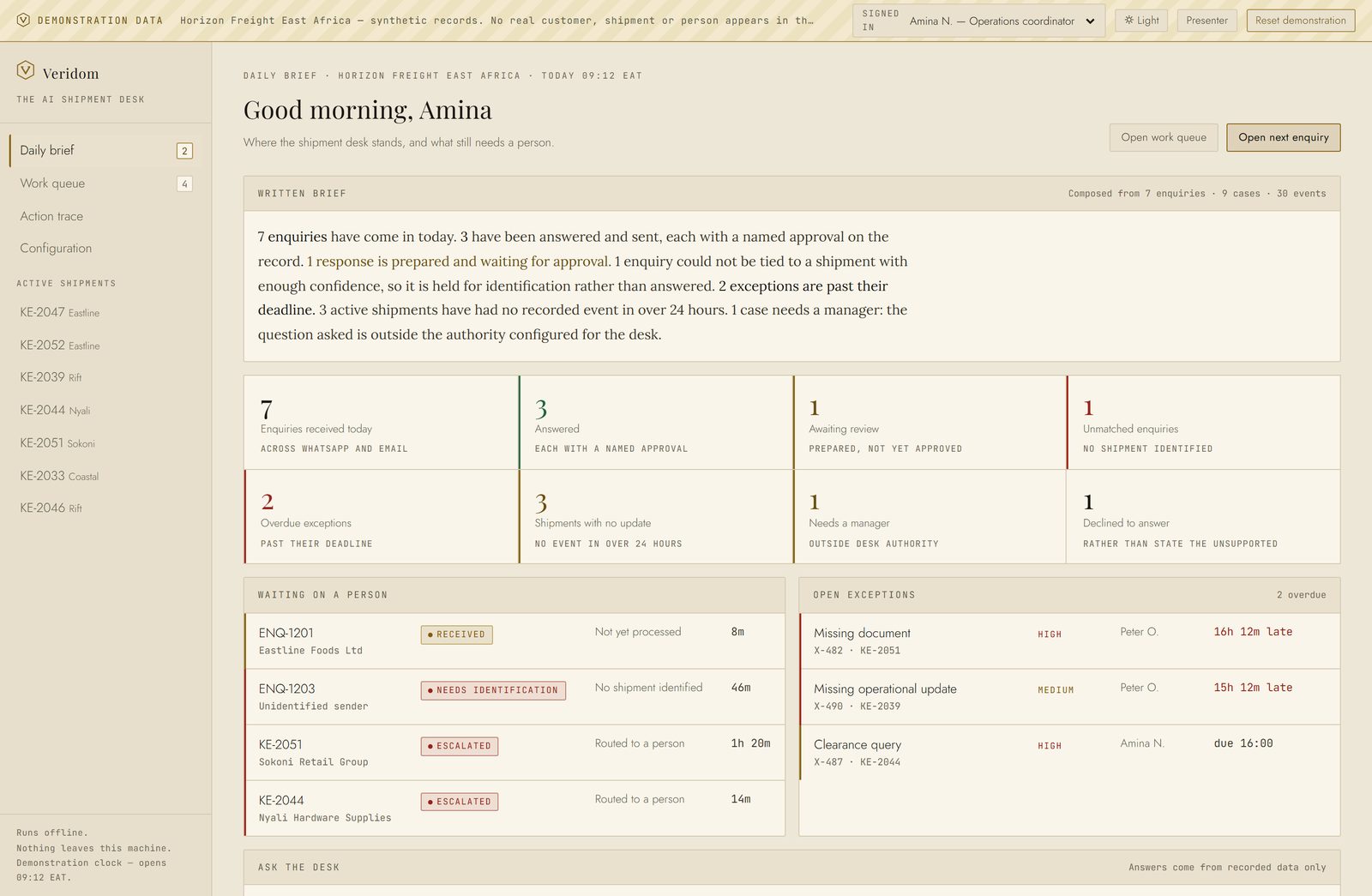
The AI Shipment Desk daily brief showing enquiries received, answered, awaiting review and declined
The daily brief. Seven enquiries in, three answered with a named approval on the record, one held for identification rather than answered, and one declined rather than stated unsupported. Demonstration data.
  • 01
    Enquiry intake from the channels you already use

    WhatsApp and email, in the customer’s own words. No portal for your customer to learn and no format for them to get right.

  • 02
    Customer and consignment matching

    Resolves who is asking and which shipment they mean, and asks for clarification rather than guessing when the enquiry is genuinely ambiguous.

  • 03
    Answers drawn only from verified records

    Every material statement in a reply is traceable to the record it came from. Observed facts are kept separate from inference, and the difference is visible.

  • 04
    Missing-answer detection

    It detects the part of a request it cannot support — which is the part that matters — rather than answering the easy half and going quiet on the rest.

  • 05
    Exception routing with a named owner

    What it cannot answer becomes a work item with an owner, a reason and an age, instead of a silence the customer has to chase.

  • 06
    Human approve, edit or reject

    Correction is a first-class action, not an escape hatch. What a person changed, and why, becomes part of the record.

  • 07
    A work queue and a daily operating brief

    What is unresolved, what is aging, what is waiting on a decision — before the day starts rather than after the complaint.

  • 08
    A complete account of what was done

    Every answer, refusal, approval and escalation is recorded with its basis. Months later, the question “why did we tell them that?” has an answer.

04 / THE DIFFERENCE

A confident wrong answer costs more than a slow right one.

The centrepiece of this product is not the answering. It is the refusing.

A general-purpose assistant pointed at your operation will produce a fluent reply to almost any question, because producing fluent replies is what it does. In freight that is dangerous: a wrong ETA quoted to a client becomes a commitment, a wrong charge quoted becomes a dispute, and a wrong clearance status quoted becomes a claim against you.

The AI Shipment Desk separates what was observed from what was inferred, and it will not state something the record does not support. When it is uncertain, it stops and routes rather than inventing certainty. That behaviour is the product, and it is why this is safe to put near a customer.
04.1 / ON THE SCREEN

Months later, “why did we tell them that?” has an answer.

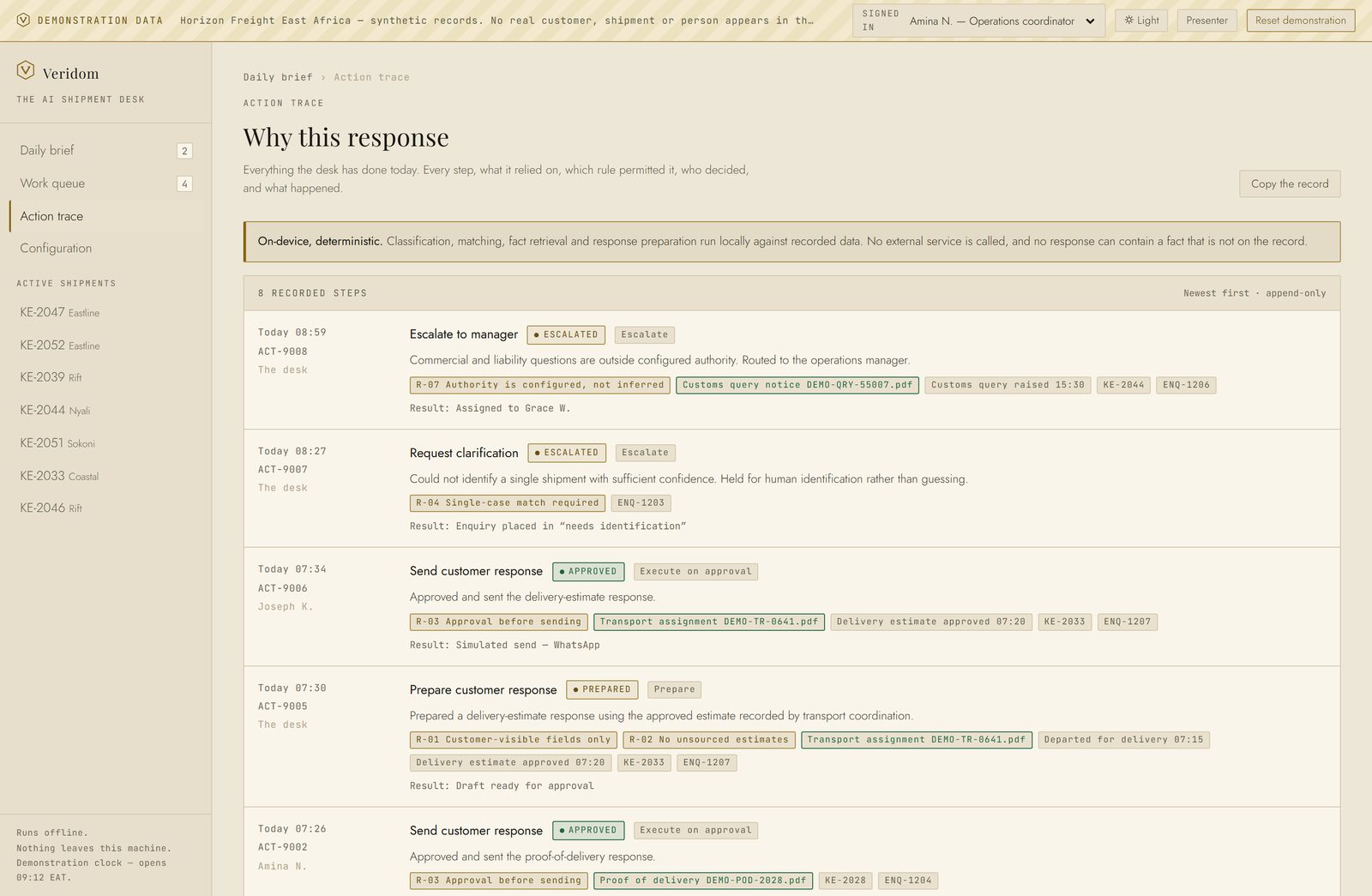
The AI Shipment Desk action trace showing every action with its basis, rule and approver
The action trace. Every answer, refusal, approval and escalation with the rule it acted under and the person who authorised it. Demonstration data.

05 / WHERE YOU SET THE LINE

You decide how far it goes — and you can move that line.

The question is almost never whether AI can do something. It usually can. The question is what you are willing to let it do without asking, on which categories of work, and how you change your mind later. That is a governance decision, and it belongs to you.

Capability and authority are separate dials. Most tools ship them welded together — whatever the model can do, it does. Here they are set independently, per category of action, and you hold the second one.

  • 01  Observe

    It reads your authorised sources and keeps an event history. Nothing acts, nothing is sent. This is where every category starts on day one.

  • 02  Recall

    It answers questions with evidence, sources and stated uncertainty. A coordinator asks; it retrieves. Still nothing leaves the building.

  • 03  Recommend

    It proposes the next action — chase this document, escalate this query, this consignment has had no event in 24 hours — and a person decides.

  • 04  Prepare

    It drafts the customer response, the entry, the exception note or the client submission and holds it for approval. Most operations sit here for the first month, on most categories.

  • 05  Execute within bounds

    It sends, files or updates on its own — but only in the categories you have opened, inside thresholds you set, where the action is reversible and recorded. Routine status replies go here early. Anything touching money goes here late, or never.

  • 06  Escalate and learn

    It recognises the novel or high-consequence case, refuses rather than improvising, routes it to a named person, and the resolution becomes part of what it knows.

Each category of work sits at its own level, written down before deployment and changed only by you. Answering “has it been released?” might reach level 5 in week two. Accepting a demurrage charge stays at level 3 permanently, because that is judgement and judgement is what your people are for. The line moves when the measurement earns it, not when a vendor wants a case study.

06 / THE IMPLEMENTATION

One workflow. Live in 14 days. Measured for 30. Continue only if it works.

A fixed implementation fee covers rapid mapping, configuration, testing, deployment and a thirty-day measurement period against how the workflow ran before. Recurring operation begins only if you choose to continue.

14days to live
30days measured
1workflow at a time
0lock-in if it fails

07 / QUESTIONS

What forwarders ask before they say yes.

If yours is not here, ask it on WhatsApp. You will get a straight answer, not a brochure.

01Can AI accurately answer customer shipment enquiries?

It can when the answer is constrained to your verified records rather than generated from a model’s general knowledge. The AI Shipment Desk retrieves the current operational state, answers only what that state supports, shows the source for each material statement, and refuses the rest. Accuracy here is an architecture decision, not a model-quality question — which is why the refusal behaviour matters more than the fluency.

02Is this just a chatbot with our documents in it?

No. A document chatbot retrieves text and paraphrases it. This works from operational state — which consignment, which event, which stage, which customer may be told what — and its output is a case action rather than a conversation. The case, not the chat, is the system of record. If nothing operational changed, nothing happened.

03What happens when it does not know the answer?

It says so, specifically. It identifies which part of the enquiry it cannot support from the record, creates an exception with a named owner and a reason, and does not send a partial reply that reads as complete. Detecting the unanswerable part is treated as a core capability, not a failure mode.

04Does it need to connect to our TMS or tracking system?

It reads from whatever authorised sources you have — a tracking system, a spreadsheet, an email account, a WhatsApp export. The mapping stage establishes which source is authoritative for each fact. If you have no system at all, the Delivery Desk is usually the better starting point, because it creates a record rather than reading one.

05Will it message our customers directly without us seeing it?

Only if you decide it should, per category of message, in writing, after the measurement period. The default is that it prepares and a person releases. Sending is an authority setting, not a feature that arrives switched on.

06How is this different from a WhatsApp auto-responder?

An auto-responder replies with a fixed message regardless of what was asked. This identifies the customer and the consignment, retrieves the actual current state, decides what that customer may be told, and escalates what it cannot verify. The auto-responder is a doormat; this is a coordinator that knows when to stop.

07How long until it is live, and what does it cost?

One workflow live in fourteen days on a fixed implementation fee agreed in writing before we start, covering mapping, configuration, testing, deployment and a thirty-day measurement period. The Kenyan market benchmark for an AI pilot is four to eight weeks on an open-ended engagement. Recurring operation begins only if you choose to continue.

08Is our customer and shipment data safe?

We sign an NDA and a data-processing agreement before any of your records are involved, and the mapping stage defines what personal data the workflow touches, where it is held, who may see it and how long it is kept — consistent with Kenya’s Data Protection Act. Your rates, clients and documents remain yours.

ONE WORKFLOW · LIVE IN 14 DAYS · MEASURED FOR 30

Stop answering the same question.

Thirty minutes with the people who actually answer the enquiries is enough to scope the first implementation and tell you honestly what can be automated now, what needs fixing first, and what should stay with a person. You keep the workflow map either way.

NAIROBI, KENYA · FIXED-SCOPE IMPLEMENTATION · ONE WORKFLOW AT A TIME

Running an owner-operated transport business with no systems to read from? The Delivery Desk creates the record instead of reading one. Or start with the overview of AI for logistics operations.